Bonjour, mes amis! Ça va? Let’s gather ’round the café table, shall we? The aroma of coffee fills the air, perfect for chatting about… German! Ja, Deutsch! Don’t run away! We’re not tackling Goethe today. Instead, we’re going to explore something quite useful: les verbes de modalité. Modal verbs! Sounds intimidating, non? Trust me, they’re your friends.
What are modal verbs, you ask? Think of them as helping verbs. They add a shade of meaning to the main verb. They don’t describe an action outright; they tell us how the action is done, or if it’s allowed, possible, or necessary. Think of them like little spices you add to your cooking – they elevate everything!
The Usual Suspects: Introducing the Modal Verbs
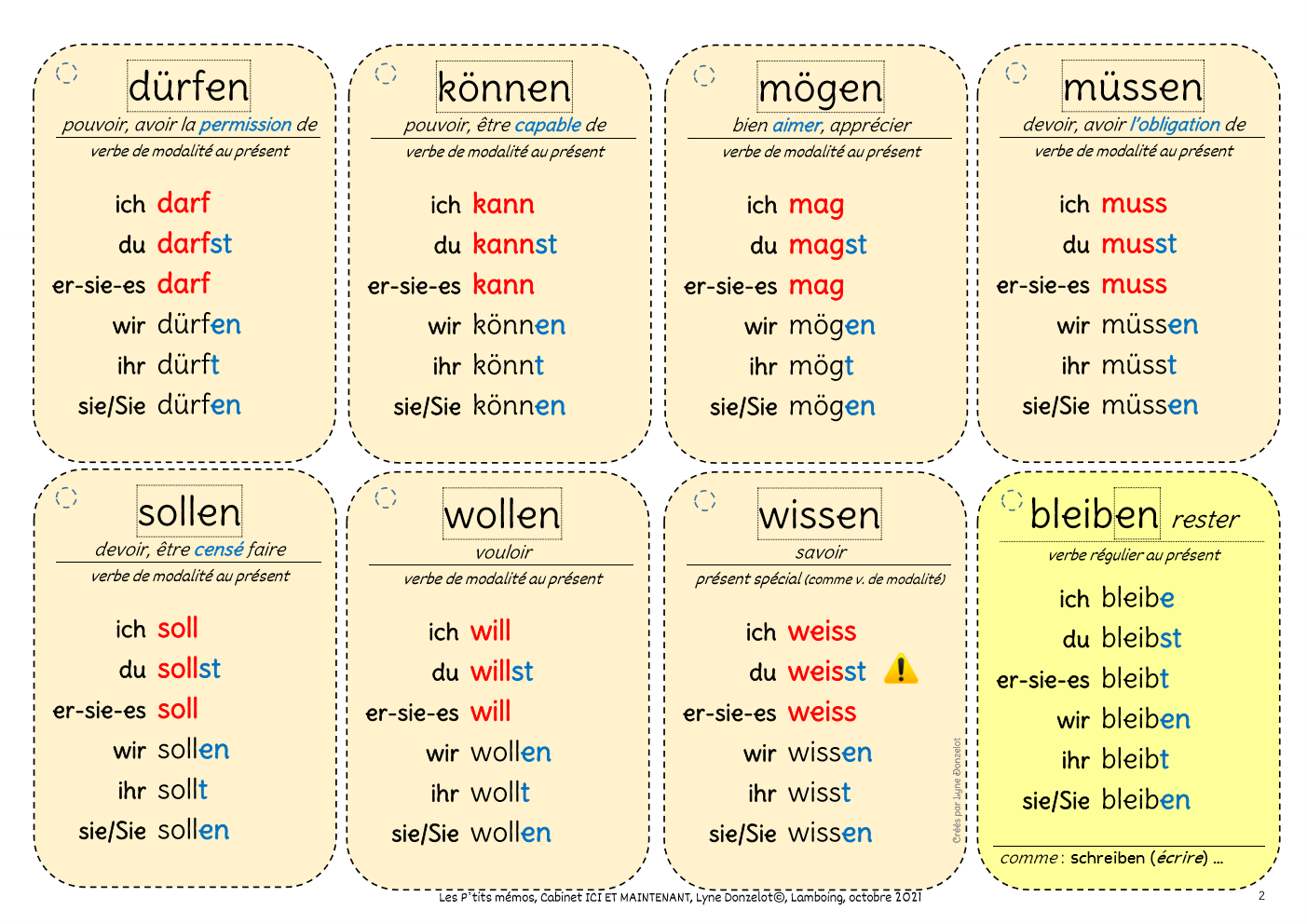
In German, we have six main modal verbs. Ready to meet them?
- dürfen: to be allowed to, may
- können: to be able to, can
- müssen: to have to, must
- sollen: should, ought to
- wollen: to want to, wish to
- mögen: to like to (often seen as “möchte” – would like to)
See? Not so scary! Now, let’s break them down one by one. And don’t worry, we’ll keep it light and fun, like a stroll through the park on a sunny day!
Dürfen: Permission Granted!
Dürfen essentially means “to be allowed to” or “may.” It indicates permission or possibility. Think of it as the verbal equivalent of a green light!
For example:
Ich darf hier parken. (I am allowed to park here.)
Darf ich Sie etwas fragen? (May I ask you something?) – This one’s super useful!
Notice how dürfen conjugates! Like all verbs, it changes its form depending on the subject. You’ll get the hang of it!
Können: The Power of Ability!
Können means “to be able to” or “can.” It describes an ability or a possibility. This one’s about your superpowers! Can you fly? Ich kann nicht fliegen! (I can’t fly!)
Example time:
Ich kann Deutsch sprechen. (I can speak German.) – Bravo!

Wir können ins Kino gehen. (We can go to the cinema.) – Sounds fun!
Können also suggests a possibility depending on the context. Remember context is your friend in any language!
Müssen: Duty Calls!
Müssen means “to have to” or “must.” It indicates a necessity or obligation. Think of it as your internal alarm clock telling you it’s time to get out of bed! Ugh.
Examples:
Ich muss arbeiten. (I have to work.)
Du musst deine Hausaufgaben machen. (You must do your homework.)
Müssen can also express a strong assumption, like in this sentence: “Das muss teuer sein!” (That must be expensive!).
Sollen: Advice and Obligations
Sollen is a bit trickier. It translates to “should” or “ought to.” It often implies advice, suggestion, or a moral obligation. Someone else thinks you should do something. Maybe your mom?
Examples:

Du sollst mehr Obst essen. (You should eat more fruit.) – Good advice!
Ich soll meine Oma besuchen. (I should visit my grandma.) – Yes, you should!
Sollen can also indicate a directive given by someone else. “Du sollst das tun!” (You are supposed to do that!).
Wollen: Expressing Your Will!
Wollen means “to want to” or “to wish to.” It expresses a desire or intention. It’s all about what you want!
Examples:
Ich will ein Eis essen. (I want to eat an ice cream.) – Me too!
Wir wollen nach Berlin fahren. (We want to go to Berlin.) – Excellent choice!
Wollen indicates a firm intention. You’ve made up your mind!
Mögen: Liking it! (and Möchte)
Mögen means “to like to.” However, you’ll most often see it in the form möchte, which means “would like to.” It’s a polite way of expressing a wish.

Examples:
Ich möchte ein Bier bestellen. (I would like to order a beer.) – Cheers!
Wir möchten gern helfen. (We would like to help.) – How kind!
While mögen exists, möchte is far more common. Make sure you know it!
The Sentence Structure Secret
Here’s the magical formula for using modal verbs in German sentences:
Subject + Modal Verb (conjugated) + Object (if any) + Main Verb (in the infinitive)
The modal verb gets conjugated, just like a normal verb, based on the subject (ich, du, er, sie, es, wir, ihr, sie). The main verb, the actual action, goes all the way at the end in its infinitive form! Don’t forget this! It’s crucial.
Let’s break down a sentence:
Ich muss Deutsch lernen. (I have to learn German.)

- Ich (Subject)
- muss (Modal verb conjugated)
- Deutsch (Object)
- lernen (Main verb in infinitive)
See? It’s not rocket science! Practice makes perfect, though.
A Little Practice, a Lot of Progress
Let’s translate a few sentences together, shall we? This will cement your understanding. Remember to consider context and nuance when choosing the right modal verb.
1. “She can sing.” – Sie kann singen.
2. “We must go home.” – Wir müssen nach Hause gehen.
3. “He wants to travel to Italy.” – Er will nach Italien reisen.
4. “You should read this book.” – Du sollst dieses Buch lesen.
5. “I would like to drink coffee.” – Ich möchte Kaffee trinken.
How did you do? Don’t worry if you stumbled a bit. It takes time and practice! Remember, every little step counts.
Don’t Be Afraid to Make Mistakes!
Learning a language is like dancing. You’ll step on some toes, stumble a bit, but eventually, you’ll find your rhythm. Don’t be afraid to make mistakes! They’re part of the process. Embrace them! Laugh about them! The important thing is to keep dancing, keep learning, and keep practicing.
Now, go forth and conquer those modal verbs! Du schaffst das! (You can do it!) And remember, the world is waiting to hear your voice, even if it’s just to order a coffee in German. You’ve got this!




+en.+ich+mag.+ø..jpg)