Okay, picture this: you’re at a party, right? And you’re chatting with this super intellectual person who’s just dropped some seriously mind-blowing philosophy bomb. You’re nodding, pretending you understand everything, but inside you’re thinking, “Woah, this is deep… but like, really deep.” That’s kinda how I felt the first time I stumbled upon Diderot’s Supplément au voyage de Bougainville. Except instead of a party, it was a dusty library, and instead of philosophy, it was… well, kinda philosophy. And sex. And colonialism. All wrapped up in a neat little eighteenth-century package. Prepare yourselves!
But first, a quick disclaimer: I’m no expert! I’m just a curious person sharing my thoughts. So, if you’re a Diderot scholar, please be gentle. This is more like a “let’s discuss this over coffee (or maybe wine?)” kind of vibe, alright?
Bougainville: The Explorer as a Catalyst
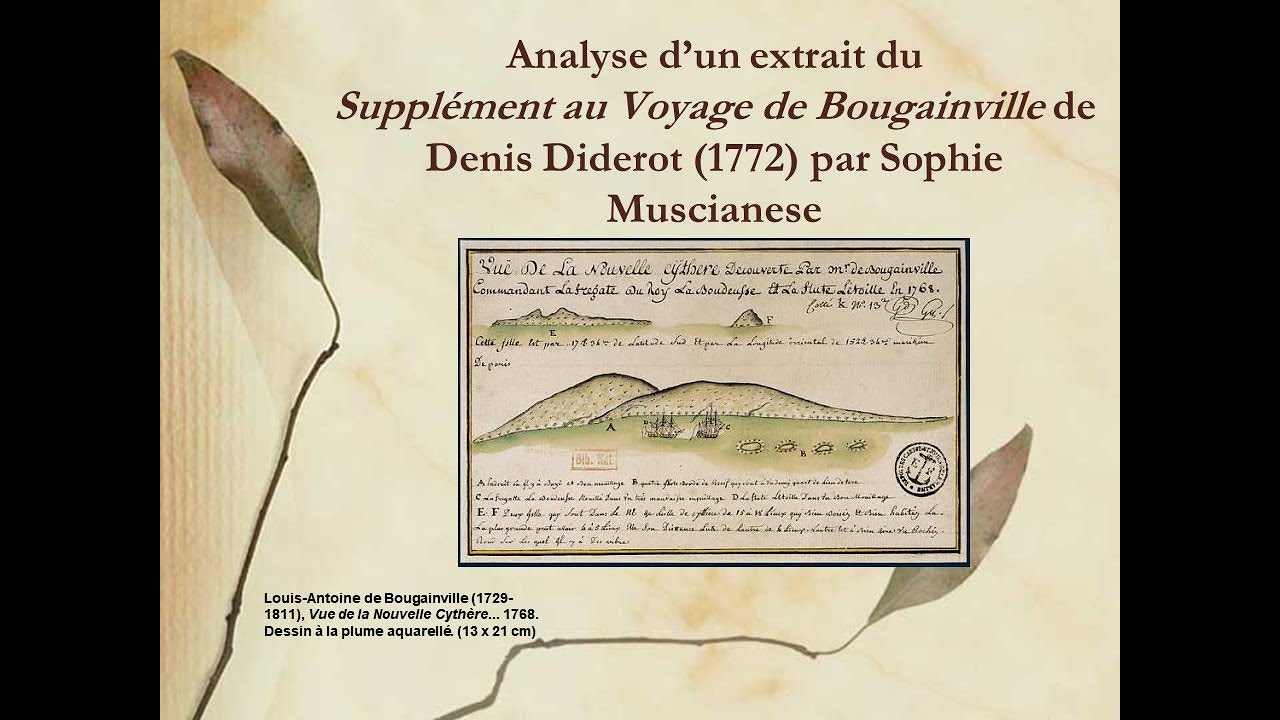
So, who’s Bougainville? Louis-Antoine de Bougainville was a French explorer who sailed around the world in the late 1760s. He was a big deal back then. His voyages brought back tales of exotic lands, new flora and fauna, and… well, people. People living very, very differently from the French.
Diderot, being the ridiculously clever and provocative guy he was (seriously, read Jacques le fataliste if you want a good laugh), saw Bougainville’s journey as a fantastic opportunity to poke holes in established European norms. He wasn’t interested in just maps and botanical specimens; he was interested in the implications of encountering a completely different culture. He used Bougainville’s voyage as a springboard to explore ideas about morality, sexuality, and the inherent goodness (or badness) of human nature. Très intéressant, non?
Tahiti: A Paradise Lost?
Central to Diderot’s argument is Tahiti. Bougainville described Tahiti as a sort of paradise, and Diderot seized on that. He presents the Tahitians as living in a state of natural innocence, free from the artificial constraints of European society. They’re happy, healthy, and, crucially, not ashamed of their sexuality. Can you imagine the uproar this caused back in the day? This was definitely scandalous!

But here’s the kicker: Diderot doesn’t just present Tahiti as a simple utopia. He uses it to critique European society. He asks: Are we really more civilized than the Tahitians? Are our laws and customs actually making us unhappier? Is our obsession with property and social status actually destroying our freedom?
The Critique of Colonialism: A Moral Minefield
This is where things get really interesting (and a little uncomfortable). Diderot’s Supplément isn’t just a celebration of Tahitian culture; it’s a scathing indictment of colonialism. He highlights the hypocrisy of Europeans who claim to be bringing civilization to these “savage” lands, while simultaneously exploiting them for their resources and imposing their own values. Think of it as a really, really early form of anti-colonial discourse.

He illustrates this brilliantly through the character of the Old Tahitian. This wise elder confronts the French explorers and accuses them of bringing disease, corruption, and unhappiness to Tahiti. His speech is powerful and heartbreaking. He essentially tells them, “You came here and ruined everything!” It’s a pretty blunt message, and Diderot doesn’t shy away from the uncomfortable truths it reveals.
Here are some of the key criticisms Diderot levels against colonialism through the Old Tahitian and other characters:
- The introduction of private property: Diderot argues that private property is the root of much evil. He sees it as creating inequality, greed, and conflict. The Tahitians, in his view, live in a communal society where resources are shared, leading to greater happiness and harmony. It’s a pretty radical idea, especially for the 18th century!
- The imposition of European morality: Diderot challenges the notion that European morality is superior to other cultures. He questions the rigid sexual codes and the emphasis on chastity and fidelity. He suggests that the Tahitians’ more open and relaxed attitude towards sexuality is actually healthier and more natural.
- The destruction of indigenous cultures: Diderot laments the inevitable destruction of Tahitian culture as a result of European contact. He recognizes that the Tahitians will be forced to adopt European customs and beliefs, losing their unique identity in the process. It’s a tragic and deeply unfair outcome.
The Dialogue Form: Diderot’s Clever Trick
The Supplément isn’t a straightforward essay. It’s written as a dialogue between two characters, A and B. This allows Diderot to explore different perspectives and to present complex ideas in a more engaging way. A is more conventional, representing the “enlightened” European viewpoint, while B is more radical, challenging A’s assumptions and pushing him to reconsider his beliefs.
It’s like a philosophical tennis match! Back and forth, back and forth. This dialogue format allows Diderot to raise uncomfortable questions without necessarily providing easy answers. He’s more interested in sparking debate than in delivering a definitive conclusion.

Sex, Lies, and Enlightenment
Let’s talk about sex. Diderot, like many Enlightenment thinkers, believed that reason and nature should be our guides. In the Supplément, he uses the example of Tahitian sexuality to challenge European sexual norms. The Tahitians, according to Diderot, engage in sex freely and openly, without shame or guilt. This, he argues, is more natural and healthier than the repressed sexuality of European society. Prepare for some raised eyebrows, even today!
Now, it’s important to remember that Diderot wasn’t necessarily advocating for unrestrained promiscuity. He was using the example of Tahitian sexuality to question the artificial constraints that European society placed on human desire. He believed that we should be more honest and open about our sexuality, and that we should strive to create a society where sex is not a source of shame or guilt.
Why Should We Care About This Today?
Okay, so Diderot was writing in the 18th century. Why should we care about his ideas today? Because the themes he explored in the Supplément au voyage de Bougainville are still relevant! We’re still grappling with the legacy of colonialism, with questions of cultural relativism, and with the tension between individual freedom and social norms. And don’t even get me started on the ongoing debates around sexuality!
Think about it. We still struggle with issues of cultural appropriation, with the impact of globalization on indigenous cultures, and with the question of whether Western values are truly universal. Diderot’s work reminds us to be critical of our own assumptions and to be open to different ways of life. And that, my friends, is a lesson worth learning. So, next time you’re at that intellectual party (or, you know, just browsing a bookstore), remember Diderot and his Tahitian adventure. It might just change the way you see the world. Or at least give you something interesting to think about. And that’s worth it, right?
So, what do you think? Are the Tahitians idealized? Is Diderot being overly critical of European society? I’d love to hear your thoughts in the comments below (if this were a real blog, of course!). And hey, maybe we can even grab a coffee (or wine?) and discuss it further. Until next time!