Okay, imagine this: I was making crêpes the other day (yes, I make crêpes, deal with it!), and I noticed something interesting. The first crêpe was… well, let’s just say it wasn’t my finest work. The second was a bit better. And by the fifth, I was practically a crêpe Picasso! That, my friends, is a real-life example of a sequence – and more specifically, a strictly increasing sequence. (Don’t tell anyone the first few crêpes ended up in the bin… that’s our little secret).
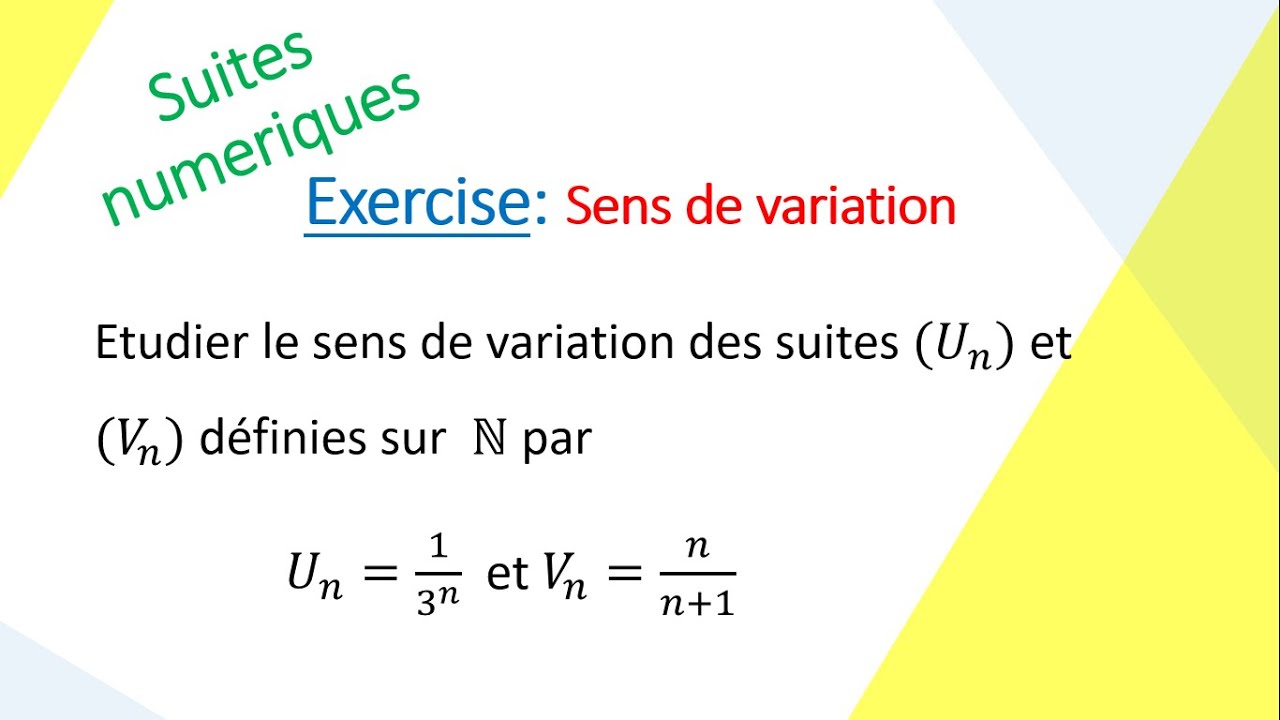
Now, crêpes aside, let’s dive into the fascinating (and sometimes terrifying) world of sens de variation d’une suite. It sounds fancy, I know, but it’s really just about figuring out if a sequence is going up, going down, or staying roughly the same. So, put your math hats on, and let’s get started!
What Exactly IS “Sens De Variation”?
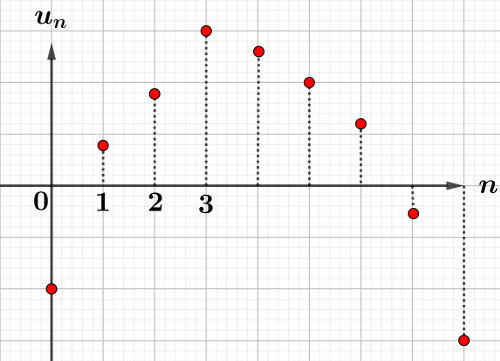
Simply put, the “sens de variation” of a sequence describes whether the terms of the sequence are increasing, decreasing, or constant as you move from one term to the next. Think of it like a tiny roller coaster for numbers!
We have three main possibilities:
- Croissante (Increasing): Each term is greater than or equal to the previous one. Think of your bank account hopefully (unless you’re buying too many crêpe ingredients!).
- Décroissante (Decreasing): Each term is less than or equal to the previous one. Think of the temperature outside as winter approaches. Brrr!
- Constante (Constant): All the terms are equal. Like if you decided to make exactly the same crêpe five times in a row (monotonous, but efficient, I guess?).
Now, sometimes we have the terms strictly increasing or decreasing. That means that equality is never allowed. For example:
- Strictement Croissante (Strictly Increasing): Each term is strictly greater than the previous one. un+1 > un for all n.
- Strictement Décroissante (Strictly Decreasing): Each term is strictly less than the previous one. un+1 < un for all n.
Side note: “Monotone” means either increasing or decreasing (but not both at the same time! And can include the “or equal to” case). “Strictement monotone” means strictly increasing or strictly decreasing. Got it? Good!
Methods for Determining the Sens De Variation
Alright, time to roll up our sleeves and get into the techniques we use to figure out the “sens de variation”. There are a few main approaches:
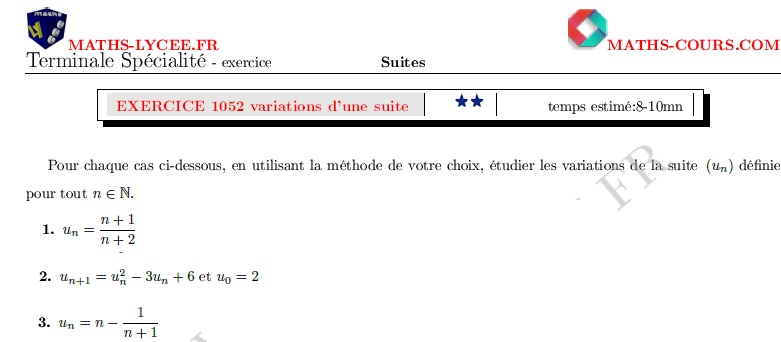
1. Comparing un+1 and un
This is the bread and butter of determining the “sens de variation”. The idea is simple: we look at the difference between a term and its successor (un+1 – un). This will let us know if the sequence is going up or down.
- If un+1 – un > 0 for all n, then the sequence is strictly increasing.
- If un+1 – un < 0 for all n, then the sequence is strictly decreasing.
- If un+1 – un ≥ 0 for all n, then the sequence is increasing.
- If un+1 – un ≤ 0 for all n, then the sequence is decreasing.
- If un+1 – un = 0 for all n, then the sequence is constant.
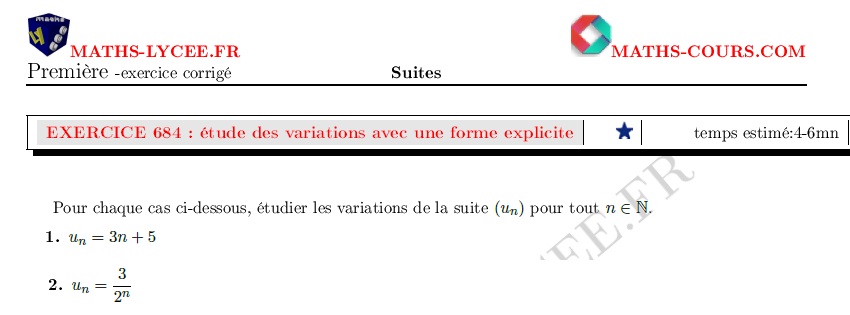
Example: Let’s say un = 3n + 1. Then un+1 = 3(n+1) + 1 = 3n + 4. So, un+1 – un = (3n + 4) – (3n + 1) = 3. Since 3 > 0, the sequence is strictly increasing!

2. Using Functions
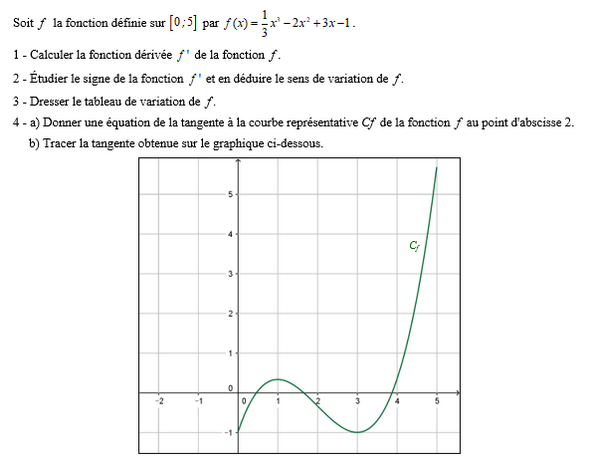
Sometimes, our sequence is defined by a function, like un = f(n). In this case, we can use what we know about the function’s derivative to figure out the “sens de variation” of the sequence.
If f(x) is an increasing function, then un = f(n) will be an increasing sequence. And if f(x) is a decreasing function, then un = f(n) will be a decreasing sequence.
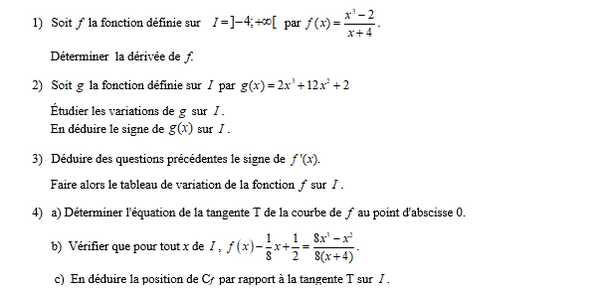
Remember your calculus? If f'(x) > 0, then f(x) is increasing. If f'(x) < 0, then f(x) is decreasing. So, find the derivative, analyze its sign, and voila! You know the "sens de variation" of the sequence.
Example: Let’s say un = n2. We can think of this as f(x) = x2. The derivative is f'(x) = 2x. For x > 0 (which is what we care about, since n is usually a natural number), f'(x) > 0. Therefore, the sequence un = n2 is strictly increasing.
3. The Quotient Method (For Positive Sequences)
This method is handy when your sequence involves multiplication or division. The key is to look at the ratio un+1 / un. Important: This only works if all the terms of your sequence are positive!
- If un+1 / un > 1 for all n, then the sequence is strictly increasing.
- If un+1 / un < 1 for all n, then the sequence is strictly decreasing.
- If un+1 / un ≥ 1 for all n, then the sequence is increasing.
- If un+1 / un ≤ 1 for all n, then the sequence is decreasing.
- If un+1 / un = 1 for all n, then the sequence is constant.
Example: Let’s say un = 2n. Then un+1 = 2n+1. So, un+1 / un = 2n+1 / 2n = 2. Since 2 > 1, the sequence is strictly increasing.

Corrigé d’Exercice (Example Exercise with Solution)
Let’s put these methods into practice with a typical exercise. Get your pencils ready!
Exercise: Determine the “sens de variation” of the sequence defined by un = (n + 1) / (2n + 3) for n ≥ 0.
Solution:
We’ll use the method of comparing un+1 and un. First, let’s find un+1:
un+1 = ((n + 1) + 1) / (2(n + 1) + 3) = (n + 2) / (2n + 5)
Now, let’s calculate the difference un+1 – un:
un+1 – un = (n + 2) / (2n + 5) – (n + 1) / (2n + 3)

To subtract these fractions, we need a common denominator: (2n + 5)(2n + 3)
un+1 – un = [(n + 2)(2n + 3) – (n + 1)(2n + 5)] / [(2n + 5)(2n + 3)]
Now, let’s expand the numerator:
un+1 – un = [2n2 + 7n + 6 – (2n2 + 7n + 5)] / [(2n + 5)(2n + 3)]
Simplify the numerator:
un+1 – un = [1] / [(2n + 5)(2n + 3)]
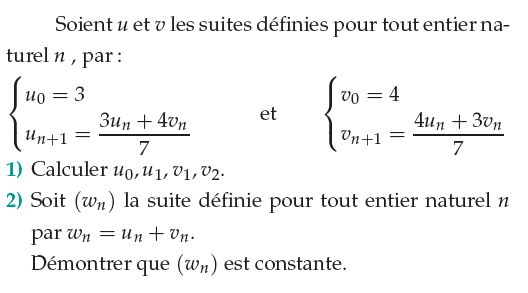
Since n ≥ 0, both (2n + 5) and (2n + 3) are positive. Therefore, the denominator (2n + 5)(2n + 3) is positive, and the entire fraction is positive:
un+1 – un > 0
This means that the sequence un = (n + 1) / (2n + 3) is strictly increasing.
Phew! That was a bit of algebra, but we got there! See? It’s not that scary.
Tips and Tricks
- Always check the domain: Sometimes, your sequence is only defined for certain values of n. This can affect the “sens de variation”.
- Don’t be afraid to calculate a few terms: Sometimes, just looking at the first few terms can give you a good idea of whether the sequence is increasing or decreasing. This can be a good way to check your work.
- Practice, practice, practice! The more exercises you do, the more comfortable you’ll become with these techniques.
So, there you have it! The “sens de variation” of a sequence, demystified. Now go forth and analyze those sequences! And maybe make some crêpes afterward. Just saying…
Remember, the key is to understand the underlying concepts and practice applying them. And if you ever get stuck, don’t hesitate to ask for help. After all, even the greatest mathematicians started somewhere.
And if all else fails, just remember the crêpes. They’re always a good motivation.